Neither Here Nor There: What African Cosmologies Teach Americans About Living Inside the Unknown
There is a particular kind of suffering that Americans know well. It arrives not during crisis itself, but in the waiting that surrounds it—the weeks after a job loss before the next opportunity clarifies, the months inside a marriage that may or may not survive, the years spent questioning an identity that no longer fits but has not yet been replaced. Western culture, with its relentless orientation toward resolution and productivity, offers few dignified frameworks for inhabiting such moments. The instinct is always to push through, to decide, to arrive somewhere definitive as quickly as possible.
African cosmological traditions, by contrast, have long recognized that these in-between spaces are not problems to be solved. They are thresholds—sacred, structured, and governed by wisdom as old as the continent itself.
The Threshold as Sacred Architecture
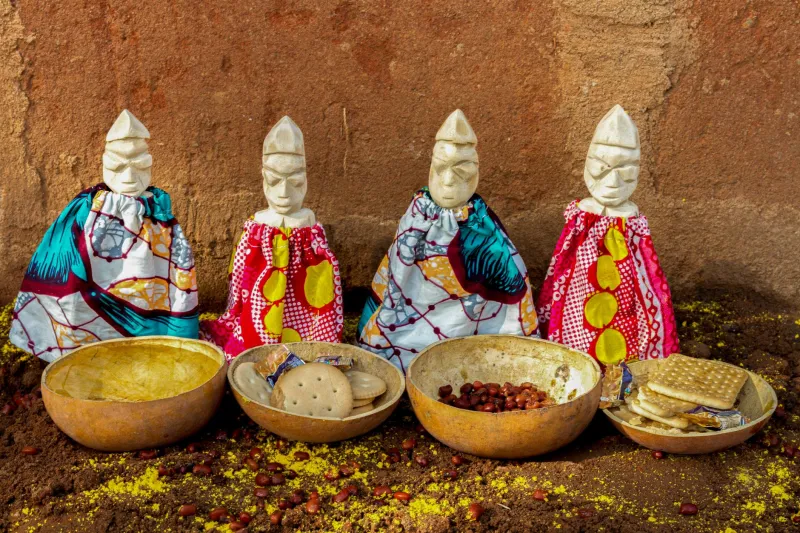
In many West African spiritual traditions, the concept of the threshold is not merely metaphorical. It is cosmological. Among the Yoruba of Nigeria, the deity Eshu Elegba—known in the African diaspora as Elegba or Legba—stands perpetually at the crossroads, the point where worlds intersect and where human beings must pause before proceeding. He is not a figure of chaos, though he is often misread as such. He is the guardian of transition itself, the intelligence that presides over every moment of genuine uncertainty.
To approach Elegba is to acknowledge that you have arrived at a place where the old map no longer applies. His presence at the crossroads is not a warning to turn back. It is an invitation to become someone who can navigate what lies ahead.
This framing is radically different from what most Americans encounter in the cultural mainstream. Where Western narratives treat uncertainty as a temporary malfunction—something to be fixed, medicated, or optimized away—Yoruba cosmology treats it as a legitimate state of being, one that demands its own rituals, its own patience, and its own form of intelligence.
Liminality as a Living Concept
The anthropologist Arnold van Gennep famously described liminal phases as the middle stage of rites of passage—the disorienting space between what one was and what one will become. What van Gennep documented in African initiation traditions, however, was not simply a sociological phenomenon. It was a spiritual technology refined across centuries.
Among the Xhosa of South Africa, initiates undergoing the ulwaluko circumcision ritual spend weeks in a liminal state, separated from their communities, stripped of their former identities, and held within a carefully constructed ceremonial container. They are not abandoned to confusion. They are guided through it by elders who have themselves made the crossing. The liminal space is not left unstructured—it is held, named, and honored as the very ground on which transformation becomes possible.
This distinction matters enormously for contemporary Americans navigating their own transitions. The absence of such containers—of elders, of ceremony, of communally recognized thresholds—leaves many people experiencing major life changes in a kind of spiritual free fall. They move through career pivots, divorces, identity shifts, and grief without any framework that tells them: this disorientation is not pathology. It is passage.
What the Ancestors Knew About Waiting
In Akan cosmological thought, from the peoples of Ghana and Côte d'Ivoire, time itself is understood differently than in the linear Western model. The concept of Sankofa—represented by a bird that flies forward while looking backward—suggests that wisdom is not found by rushing toward the future, but by remaining in dynamic relationship with what has already been lived. To stand at a threshold, in this framework, is to be held between memory and possibility, between the ancestors who have gone before and the descendants who have not yet arrived.
This is not passivity. It is a specific form of active attention—a willingness to let the threshold do its work rather than forcing premature resolution. For Americans accustomed to five-year plans and quarterly goals, this can feel deeply counterintuitive. Yet for those willing to try it, the practice of honoring the liminal—of sitting with uncertainty as a form of spiritual discipline rather than personal failure—often yields something that urgency cannot: genuine clarity.
Ritual Containers for Modern Crossroads
The practical question, of course, is how these cosmological frameworks translate into lived experience for someone in, say, Chicago or Atlanta who is three months into a layoff, or six months into a separation, or two years into a quiet identity crisis they cannot quite name.
Several African-rooted spiritual communities across the United States are actively exploring this question. Practitioners within Ifá traditions, Vodou lineages, and various Bantu-influenced spiritual systems are developing contemporary ritual containers designed to honor liminal transitions in culturally grounded ways. These may involve divination to understand what the threshold is asking of the seeker, offerings to the spiritual intelligences that govern crossroads and transition, and structured periods of reflection guided by experienced elders or priests.
What these practices share is a refusal to treat uncertainty as the enemy. Instead, they ask: What is this threshold teaching? What must be released before the crossing can be completed? What ancestral wisdom is available precisely here, in this in-between place, that would not be accessible anywhere else?
The American Hunger for Passage
There is growing evidence that Americans are hungry for exactly this kind of framework. The explosion of interest in rites of passage programs, the widespread search for meaningful ritual across religious and secular communities, and the increasing openness to non-Western spiritual traditions all point toward a cultural recognition that something essential is missing from the standard American toolkit for navigating change.
African cosmologies of liminal space do not promise to make uncertainty comfortable. They promise something more valuable: a way of being inside it that preserves dignity, invites depth, and connects the individual to something larger than personal anxiety. When Elegba stands at the crossroads, he does not tell the traveler which road to take. He teaches the traveler how to stand there long enough to hear the answer arise from within.
For a culture that has long confused speed with wisdom, that lesson may be among the most important Africa's ancient traditions have to offer.
Learning to Dwell at the Door
The threshold, in African spiritual thought, is not a failure of arrival. It is a place of its own—sovereign, instructive, and alive. To learn to dwell there, even briefly, even imperfectly, is to begin developing the kind of inner architecture that no career coach or wellness app can build on your behalf.
It is the architecture of a soul that has learned to trust the crossing—not because the destination is certain, but because the tradition of crossing is ancient, and the ancestors who made it before you are closer, in that liminal space, than they are anywhere else.