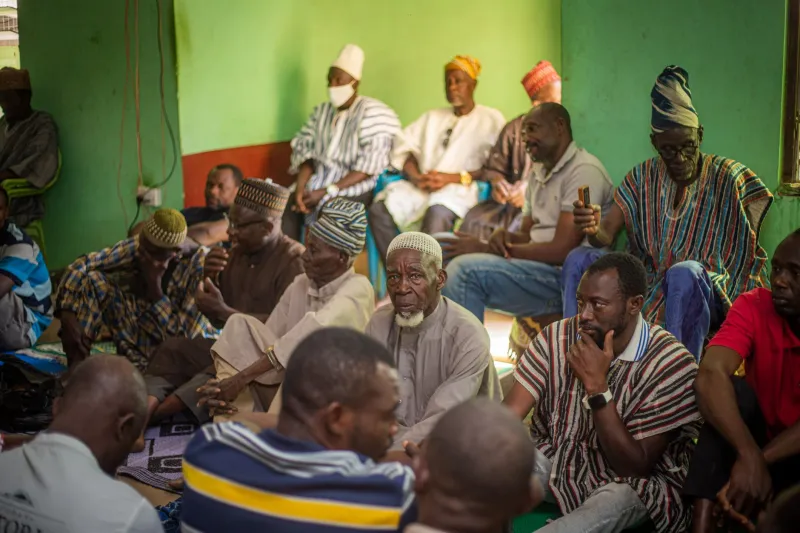
The Circle That Heals the Office: How African Palaver Traditions Are Quietly Reshaping American Workplace Culture

There is a particular kind of exhaustion that settles over a workplace where people do not feel genuinely heard. It is not the tiredness of hard work. It is the fatigue of invisibility—of speaking into rooms where words land without resonance, where conflict is managed rather than transformed, and where the human being behind the job title is perpetually overlooked. Millions of American workers know this exhaustion intimately. What they may not know is that an answer to it has existed for centuries on the African continent, encoded in a tradition known as the palaver.
What the Palaver Circle Actually Is
The word palaver derives from the Portuguese palavra, meaning "word" or "speech," and entered the English language through early colonial contact with West African coastal communities. But the practice itself is far older and far more layered than any borrowed vocabulary can convey. Across numerous African cultures—among the Akan of Ghana, the Yoruba of Nigeria, the Luba of the Democratic Republic of Congo, and many others—the palaver circle has long functioned as a sacred communal technology for resolving conflict, restoring right relationship, and ensuring that every voice within a community carries weight.
At its structural core, a palaver is a circular gathering. There is no head of the table, no hierarchy of seats. Participants speak in turn, guided by protocols that prioritize truthfulness over performance and listening over rebuttal. A designated elder or facilitator holds the space, not as a judge, but as a witness—someone whose role is to ensure that each person is fully seen and fully heard before the group moves toward resolution. The circle does not close until every voice has been honored. This is not a courtesy. It is a spiritual obligation.
Central to the palaver is a concept that scholars of African philosophy have described as communal witnessing: the understanding that a person's truth, once spoken in the presence of others who receive it with full attention, undergoes a kind of transformation. It becomes real in a way that private grievance never can. The community, by witnessing, takes on a share of responsibility for what has been spoken.
From Village Squares to American Office Floors
It may seem a significant leap from a village gathering beneath a baobab tree to a conference room in Austin or a remote team call in Chicago. Yet a growing number of American organizations are making precisely that translation—and finding the distance shorter than expected.
Consultants and facilitators trained in African philosophical traditions have begun introducing palaver-based frameworks under various names: restorative circles, accountability councils, deep-listening forums. The specific terminology varies, but the structural principles remain consistent. Participants sit or gather in a configuration that eliminates hierarchical positioning. A talking piece—an object held by the speaker—ensures that only one voice is active at a time. Listeners are asked not merely to wait for their turn, but to practice what some facilitators describe as receptive presence: the deliberate suspension of internal commentary in order to receive what is being offered.
One nonprofit organization based in Atlanta, working in the field of community health, introduced a monthly palaver-style accountability circle for its staff of forty-two following a period of significant internal conflict. Within two quarters, the organization reported a measurable decline in formal HR complaints and a notable improvement in scores on its internal employee engagement survey. The executive director, speaking at a regional nonprofit leadership conference, described the shift in language that surprised her most: staff members began referring to their colleagues as people they trusted, a word that had been conspicuously absent in exit interviews during the preceding two years.
A technology startup in Denver implemented a version of the palaver council specifically for cross-functional project teams navigating deadline pressure and resource disputes. Rather than defaulting to escalation protocols—which, the founders noted, tended to create winners and losers rather than resolution—teams were guided through a structured circle process before any formal escalation could occur. The practice did not eliminate conflict. It changed the quality of what emerged from it.
The Spiritual Architecture Beneath the Method
To understand why these practices carry such weight, it is necessary to look beneath the procedural surface and acknowledge the spiritual architecture that supports them. In African traditional thought, the act of bearing witness is not neutral. It is charged with moral and even cosmological significance. To witness another person's truth is to accept a portion of responsibility for what that truth requires. The ancestors, in many traditions, are understood to be present in such gatherings—not as metaphor, but as genuine participants whose interest in the integrity of human relationship does not diminish with death.
This framing may feel unfamiliar within the secular vocabulary of American workplace culture. Yet its practical implications translate with remarkable fidelity. When employees know that a gathering is structured around the principle that their words will be received with genuine care—that the space itself is held as sacred, regardless of how that word is understood—something in the quality of participation shifts. People speak more carefully. They listen more fully. They arrive at accountability not through coercion but through a recognition that the community around them has made itself responsible for holding their truth.
This is, at its heart, what distinguishes the palaver tradition from conventional conflict-resolution models: it does not treat human beings as problems to be managed. It treats them as members of a living community whose integrity depends on the dignity of each individual within it.
What American Workplaces Stand to Gain
The data on American workplace disengagement is well documented. Gallup's ongoing research consistently finds that the majority of U.S. employees report feeling either not engaged or actively disengaged at work. The costs—in productivity, in turnover, in healthcare expenditure related to work-related stress—run into the hundreds of billions annually. Against this backdrop, the palaver tradition offers something that no software platform or performance management system can replicate: a structured, culturally grounded practice of making people feel genuinely seen.
Retention, in particular, emerges as a domain where these practices show measurable promise. Employees who report feeling heard and witnessed by their organizations are significantly less likely to seek employment elsewhere. The connection is not incidental. It reflects something fundamental about human motivation that African communal philosophy has long understood: people do not leave jobs simply because of compensation or workload. They leave because they have ceased to feel that their presence matters.
Honoring the Source
Any engagement with these traditions in American professional contexts carries a responsibility that cannot be set aside. The palaver is not a neutral tool extracted from a cultural vacuum. It is the living inheritance of communities whose wisdom was historically suppressed, appropriated, or dismissed. Organizations that draw upon these practices are well served by acknowledging their origins explicitly—by naming the African philosophical traditions from which they derive, and by ensuring that the communities who carry these traditions are engaged as partners rather than treated as passive sources of extractable technique.
When that accountability is honored, the circle remains intact. And it is precisely the integrity of the circle—its refusal to privilege any single voice above the rest—that makes it so powerful a vessel for the kind of healing that American workplaces so urgently need.