Seen and Held: How African Traditions of Sacred Witnessing Are Answering America's Loneliness Crisis
In 2023, the United States Surgeon General issued an advisory describing loneliness as a public health crisis of extraordinary proportion. Millions of Americans, the report noted, move through their days without a single person who genuinely knows their inner life. They have acquaintances, colleagues, followers, and family members who love them in the broad strokes — and yet they remain, in the most essential sense, unseen. The advisory called for structural solutions: more community centers, more digital connection, more policy intervention. What it did not mention, and what an older body of wisdom has long understood, is that the longing to be witnessed is not merely a social problem. It is a spiritual one.
Across many African traditions, the act of communal witnessing — of gathering in a trusted circle to hear and hold another person's spoken truth — has never been understood as auxiliary to healing. It has been understood as the healing itself.
The Circle That Listens
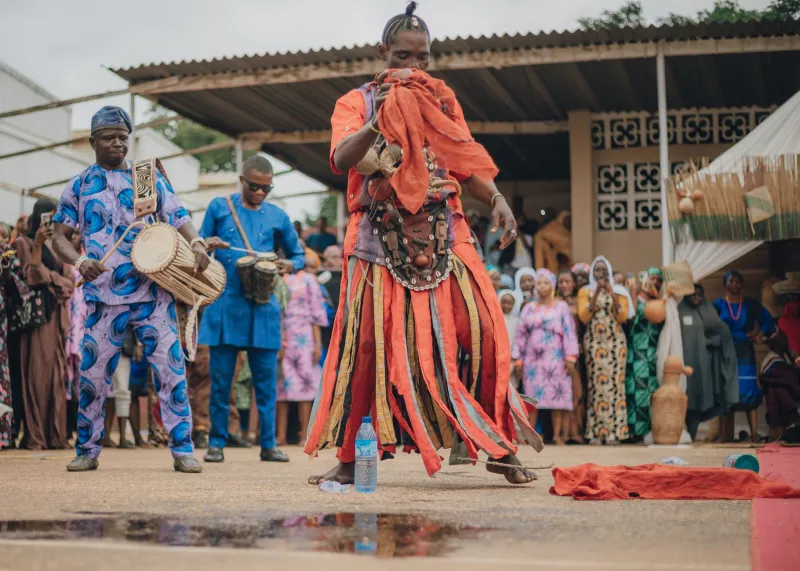
In numerous West African communities, the practice of communal storytelling within ceremonial contexts is woven into the fabric of how grief, conflict, illness, and transition are processed. Among the Dagara people of Burkina Faso, as the late scholar and teacher Malidoma Somé documented extensively, grief rituals are not private affairs conducted between an individual and a trained professional. They are communal events in which the entire village participates as an active, spiritually engaged audience. The person who weeps is not isolated in their pain; they are surrounded by others who witness the expression of that pain as a sacred offering — one that benefits not only the individual but the collective.
Similarly, within many Southern African traditions, the concept of ubuntu — often translated as "I am because we are" — carries within it a sophisticated understanding of personhood that is fundamentally relational. To be a person, in this framework, is to be recognized as such by others. Personhood is not self-generated. It is conferred, confirmed, and continuously renewed through the quality of attention that a community brings to each of its members. To be witnessed, then, is not a comfort. It is a condition of full human existence.
What Witnessing Is Not
It is important to draw a distinction that many Americans, shaped by a therapeutic culture, may initially overlook. Sacred witnessing, as practiced within African traditional contexts, is not therapy. It does not seek to diagnose, interpret, or redirect the speaker toward insight. It does not position one person as a trained expert and another as a patient in need of correction. The witness is not neutral in the clinical sense; they are present in the fullest spiritual sense. They bring their own ancestors, their own accumulated sorrow, their own humanity into the circle. The speaker is not processed. They are received.
This distinction matters enormously. Therapy, for all its genuine value, operates within a framework that is fundamentally transactional and bounded by time, credential, and professional distance. Sacred witnessing, by contrast, is an act of spiritual hospitality. The community says, in effect: Your story belongs here. We will hold it with you. You do not carry this alone.
The difference is not merely philosophical. For many people — and particularly for many African Americans whose ancestors were systematically denied the right to have their stories recognized as mattering — the experience of being witnessed within a spiritually grounded community carries a depth of healing that no fifty-minute session can replicate.
How the Practice Is Taking Root in America
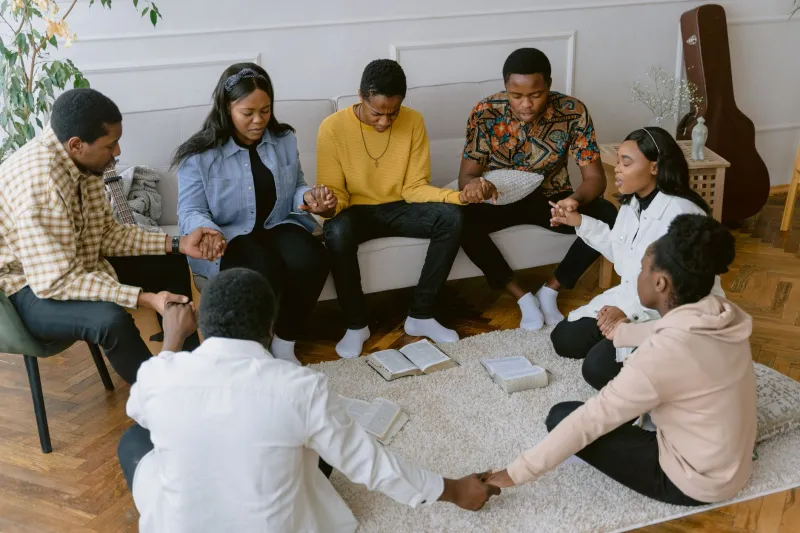
Across the United States, something is shifting. In Black churches from Atlanta to Chicago to Oakland, pastors and lay leaders are deliberately creating structured spaces for communal testimony that move beyond the traditional call-and-response of Sunday morning. These are smaller, more intimate gatherings — midweek circles, Saturday morning healing groups — in which participants are invited to speak their truths without interruption, and in which the congregation's role is explicitly framed as one of sacred presence rather than advice-giving.
In healing arts communities, particularly those led by African American women, the talking circle has become a cornerstone practice. Organizations such as those working in the tradition of the late Audre Lorde's legacy of radical vulnerability are convening circles in which the protocols of witnessing are explicitly drawn from African diasporic sources. Participants are sometimes asked to open with libation, to acknowledge the ancestors, and to hold the space with the understanding that what is spoken in the circle carries spiritual weight.
Perhaps most surprising is the emergence of witnessing practices in certain progressive American workplaces. A small but growing number of organizations, particularly those with leadership committed to racial equity and holistic employee wellbeing, have begun incorporating structured storytelling circles into their team practices. These are not trust falls or icebreakers. They are deliberate, facilitated spaces in which employees are invited to share something true about their lives, and in which colleagues are asked to receive that truth with full attention and without judgment.
The Radical Act of Full Attention
There is something almost countercultural about the practice of giving another person your complete, undivided, spiritually intentional attention. In an era of fractured focus, algorithmic distraction, and the constant pressure to perform connection rather than inhabit it, the act of truly listening has become genuinely rare. African witnessing traditions insist that this kind of attention is not merely a courtesy. It is a spiritual discipline — one that requires preparation, intentionality, and a willingness to set aside one's own interior noise in service of another person's truth.
The Zulu concept of hlonipha, which encompasses deep respect and attentiveness toward others, offers one framework for understanding why this quality of listening carries such transformative power. When a person is witnessed with hlonipha — with profound, embodied respect — they are not merely heard. They are honored. And in that honoring, something in them that has been contracted by shame, isolation, or invisibility begins, slowly, to open.
Coming Home to the Circle
For many African Americans, engaging with these traditions is not an act of cultural borrowing. It is an act of return. The communal witnessing circle was not invented in a workshop or a wellness retreat. It was carried across the Atlantic in the bodies of enslaved people who continued, under extraordinary duress, to gather in secret — to sing together, to pray together, to tell their stories to one another in the dark. The hush harbor, the ring shout, the praise house: these were all, in their way, sacred witnessing spaces. They were places where Black people affirmed to one another, against every force that sought to deny it, that their lives and their stories mattered.
To recover these practices today is to do more than address a loneliness epidemic. It is to reclaim a spiritual inheritance that was never truly lost — only waiting, in the memory of the ancestors, to be called back into use.
America is lonely because it has forgotten that the self cannot sustain itself in isolation. African wisdom has always known what the Surgeon General is only now beginning to articulate: that to be human is to need to be witnessed. And that the circle, when it gathers with intention and love, is among the most ancient and most powerful medicines the world has ever known.