When the Body Becomes the Prayer: How African Dance Traditions Are Awakening Spiritual Truth in American Seekers
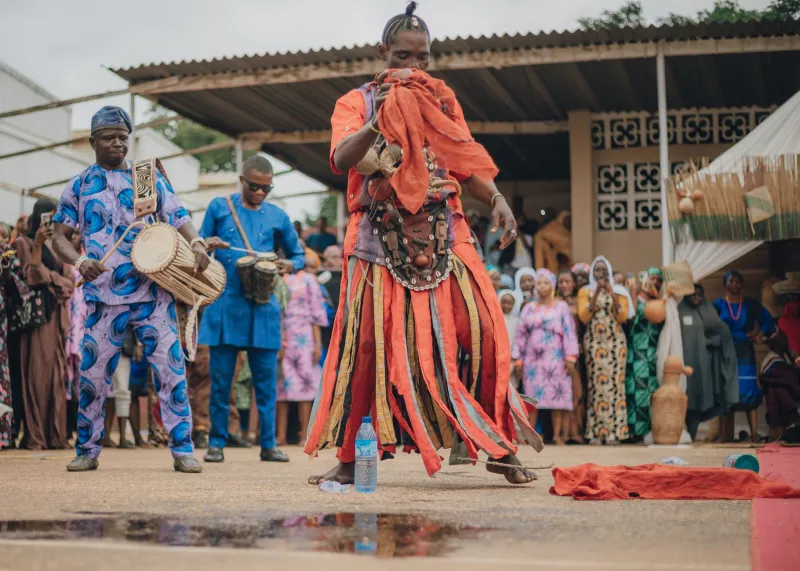
There is a moment, known to dancers across many African ceremonial traditions, when the body stops performing and begins speaking. The drumbeat no longer enters through the ears alone — it travels through the soles of the feet, rises through the spine, and radiates outward from the chest. The individual self, with all its anxious calculations and unresolved grief, momentarily steps aside. What remains is something older, something the Yoruba might recognize as àṣà — the living current of inherited tradition — moving through a human vessel.
For many Americans encountering these traditions for the first time, that moment arrives as both a revelation and a homecoming.
A Civilization That Never Separated the Body from the Sacred
To understand why African dance traditions carry such transformative power, one must first appreciate a foundational principle that distinguishes most indigenous African spiritual frameworks from the dominant currents of Western religious thought: the body is not a problem to be transcended. It is an instrument of divine communication.
In countless African cultures — from the Dagomba of northern Ghana to the Zulu of southern Africa, from the Mandinka griots of West Africa to the Shona spirit mediums of Zimbabwe — movement has historically served as one of the primary languages through which human beings speak to the unseen world and, crucially, through which the unseen world speaks back. Ceremony without dance is, in many of these traditions, incomplete. The ancestors are not merely honored in stillness; they are invited into the body through rhythm, breath, and deliberate physical expression.
This stands in pointed contrast to the Cartesian inheritance that has shaped much of Western spiritual and intellectual culture — the deeply embedded assumption that the mind and spirit occupy a realm categorically separate from, and superior to, the physical body. Many Americans raised within that framework carry the consequences: a vague but persistent sense of spiritual disconnection, an inability to access intuition, and a relationship to their own bodies characterized more by management than by trust.
The Griot's Body as Living Archive
Among the most instructive of African movement traditions for contemporary seekers is the embodied storytelling practice of the griot — the hereditary keepers of history, genealogy, and communal memory found across much of West Africa. The griot does not merely recite; the griot inhabits. Every gesture carries encoded meaning. The angle of a wrist, the rhythm of a forward lean, the specific quality of stillness between movements — all of these communicate layers of narrative and spiritual significance that words alone cannot carry.
For Americans grappling with what might be called a crisis of narrative — a widespread uncertainty about who they are, where they come from, and what their lives mean — the griot tradition offers something remarkable: the suggestion that the answers to these questions may already be stored within the body itself, waiting to be unlocked through intentional movement.
A number of West African dance educators and cultural practitioners now working in cities such as Atlanta, Brooklyn, and Oakland have begun incorporating griot movement principles into workshops explicitly designed for this kind of self-inquiry. Participants are guided not simply to learn choreography, but to use their bodies as instruments of personal and ancestral excavation.
Healing Circles and the Medicine of Collective Movement
Beyond individual practice, many African ceremonial dance traditions are inherently communal — and it is in that communal dimension that some of their most potent healing properties reside.
The healing circle dance, present in various forms across sub-Saharan Africa, operates on a principle that contemporary neuroscience is only beginning to articulate: that synchronized movement among a group of people produces measurable physiological and psychological effects, including reduced cortisol levels, heightened feelings of trust and belonging, and increased access to emotional states that are otherwise difficult to reach consciously.
In the ngoma healing traditions of East and Central Africa — a word that encompasses drum, dance, and ceremony as a unified concept — illness is understood not merely as a biological event but as a disruption in the relationship between the individual, the community, and the ancestral world. The healing dance is, therefore, not metaphorical medicine. It is a structured, spiritually supervised process of restoration that engages the body as the primary site of intervention.
American practitioners who have trained with ngoma masters report that the tradition offers something that many conventional therapeutic modalities struggle to provide: a framework for healing that does not require the suffering person to explain or intellectualize their pain before relief is possible. The body, given the right rhythmic container and communal support, begins its own process of reorganization.
What the Western Wellness World Is Beginning to Understand
It would be inaccurate to suggest that the broader American wellness culture has been entirely oblivious to these principles. The last two decades have seen significant growth in somatic therapies, embodiment practices, and trauma-informed movement modalities. Yet many of these approaches — valuable as they are — remain largely disconnected from the spiritual and ancestral dimensions that give African dance traditions their particular depth.
The difference, as several cultural practitioners are careful to emphasize, is not merely philosophical. When movement is situated within a coherent cosmology — when the dancer understands themselves to be in conversation with specific ancestral forces, with the land, with a living spiritual community — the experience carries a quality of meaning that purely secular embodiment practices cannot fully replicate.
This is why an increasing number of Americans, including many with no direct African heritage, are seeking out authentic instruction in these traditions rather than their diluted derivatives. They are not simply looking for a new form of exercise or stress relief. They are looking for what African ceremonial dance has always offered: a technology for becoming fully present in a body that is understood to be, in itself, a sacred instrument.
Approaching These Traditions with Appropriate Reverence
For Americans drawn to explore African dance traditions, cultural practitioners and scholars alike emphasize the importance of approaching these lineages with genuine humility and a willingness to learn within proper context. These are not performance styles to be borrowed casually; they are living spiritual systems with their own protocols, hierarchies of knowledge, and codes of respect.
Seeking out teachers who are themselves properly trained within their specific traditions — rather than instructors offering generic "African dance" without clear cultural grounding — is considered essential by most serious practitioners. Many recommend beginning not with the movement itself, but with the listening: attending community ceremonies where these traditions are practiced in their full context, learning the histories of the specific cultures from which individual dances originate, and allowing genuine relationship to develop before attempting to inhabit forms that carry deep ancestral weight.
The Body Remembers What the Mind Has Forgotten
There is a phrase that circulates quietly among those who have spent significant time within African ceremonial dance traditions: the body remembers what the mind has forgotten. It speaks to something that practitioners across many different African cultural contexts have observed for generations — that certain forms of knowledge, certain kinds of healing, and certain qualities of spiritual connection are simply not accessible through intellectual effort alone.
For a culture that has perhaps over-invested in the life of the mind at the expense of the life of the body, that insight carries genuine urgency. The African ceremonial dance traditions now finding new audiences across the United States are not offering Americans an exotic spiritual detour. They are offering something far more fundamental: a path back into the body as a place of wisdom, of healing, and of encounter with the sacred — a path that, for many, may prove to be the most direct route home.